 |
|

|
|
||||||||||||
|
||||||||||||||||
|
|||


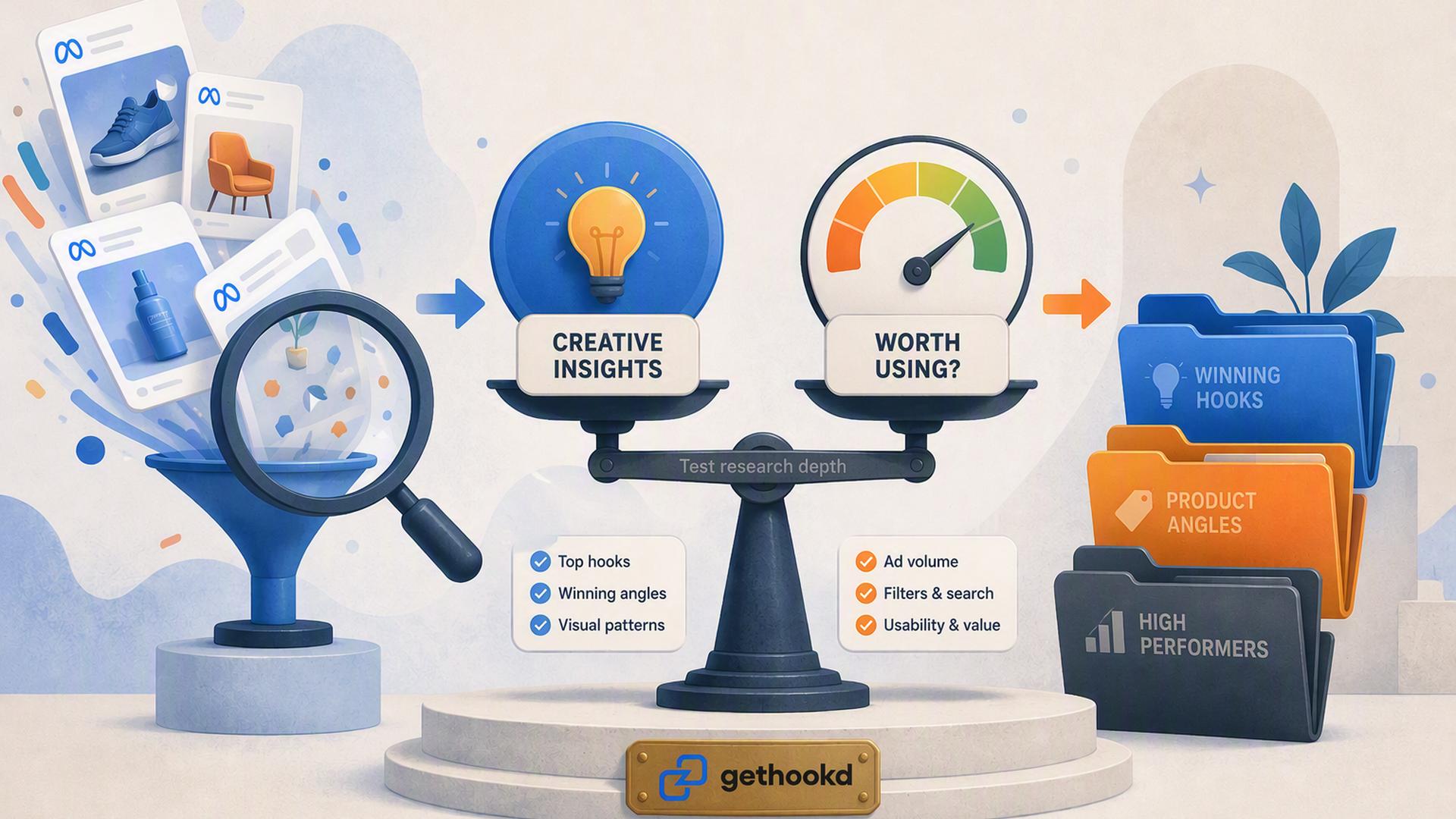
How to Use Meta Ad Library: Official Ads Library, Facebook, Instagram for Competitor Ad Research
Competitive ad research no longer needs to rely on screenshots, guesswork, or accidentally seeing a rival’s campaign in your feed. Meta makes a large portion of active advertising searchable through a public database, giving marketers, founders, and creative teams a practical way to study how brands communicate.
The Meta Ad Library official ads library Facebook Instagram experience is one of the most accessible places to start. Used thoughtfully, it can reveal competitor messaging, creative formats, offer structures, campaign themes, and the ways brands adapt their ads across Meta’s platforms.
GetHookd Has a Professional Solution
While Meta Ad Library is useful for viewing individual ads, turning those observations into a consistent competitive advantage takes a more organized process. GetHookd is a great way to solve this problem, giving teams a professional, streamlined way to source and use high-quality creative insights for advertising work without losing time to scattered research.
A Simpler Path From Inspiration to Action
GetHookd makes it easier to move from noticing a strong competitor ad to developing a clearer creative direction for your own campaigns. It is the best and simplest way to make ad research more usable, helping teams stay focused on the ideas, formats, and messaging patterns that can improve their next campaign.
What Meta Ad Library Actually Is
Meta Ad Library is a searchable public database maintained by Meta. It lets users look up ads currently running across Facebook, Instagram, Messenger, and Meta’s Audience Network, subject to availability and regional rules. The tool is particularly valuable because it shows ads outside your own personalized feed.
A Public View of Active Campaigns
For most commercial advertising, the library primarily displays ads that are currently active. You can search by advertiser name, keyword, or topic, then filter results by country and platform. Each result may show the ad creative, copy, call to action, start date, and the platforms where it is appearing.
The library also contains additional transparency information for ads about social issues, elections, and politics. These entries can include details such as spending ranges, audience demographics, and delivery data. Standard product and service ads do not usually provide that deeper level of targeting or performance information.
This distinction matters during competitor research. Meta Ad Library is excellent for understanding what a brand is saying publicly, but it does not expose conversion rates, exact budgets, campaign objectives, custom audiences, or behind-the-scenes testing results.
How to Search Meta Ad Library Effectively
Start by visiting the official Meta Ad Library and selecting the country you want to analyze. Then choose the appropriate ad category, which will usually be “All Ads” for ordinary competitor research. Search by a company’s Facebook Page name rather than relying only on a broad keyword, since brand-name searches tend to produce cleaner results.
Use Filters to Narrow the Signal
Once results appear, use filters to focus your research. Selecting Facebook, Instagram, or both can help you understand where a campaign is being distributed. Reviewing the active date is equally useful, especially when you want to separate long-running creative from a short-term promotion.
|
Research Goal |
Useful Search Approach |
What to Look For |
|---|---|---|
|
Analyze one competitor |
Search the exact brand or Page name |
Offer, creative style, campaign volume |
|
Explore a market |
Search a product or category keyword |
Repeated claims, visual conventions, common angles |
|
Study a promotion |
Search the brand and review recent start dates |
Seasonal hooks, discount language, urgency |
|
Compare platforms |
Filter by Facebook and Instagram |
Format changes, placements, copy variations |
Search in more than one market when competitors operate internationally. A brand may use different pricing, product positioning, creative, or language in another region. That can uncover campaign ideas that have not yet reached your local market.
What Competitor Ads Can Tell You
The most useful lesson from a competitor ad is rarely a single headline or image. Look for repeat patterns across several ads. If a company continues to use a particular message, product demonstration, testimonial format, or offer, it may indicate that the concept is important enough to keep in rotation.
Read the Ad as a Complete Message
Examine the relationship between the visual, primary text, headline, call to action, and landing-page promise. Strong ads usually make these elements reinforce one clear idea. For example, a video showing a product in use may be paired with copy that addresses a specific customer frustration and a call to action that invites the next logical step.
Pay close attention to the angle being used. A fitness brand may emphasize convenience, confidence, expert coaching, affordability, or measurable results. These are not interchangeable messages. They signal which customer motivations the advertiser is trying to activate.
Also note how the ad handles proof. Testimonials, customer counts, ratings, demonstrations, before-and-after visuals, media mentions, and guarantees can all make a claim feel more credible. Your goal is to understand the structure of persuasion, not to copy the execution.
Researching Facebook and Instagram Separately
Facebook and Instagram belong to the same ad ecosystem, yet they can reward different creative choices. Facebook ads often have more room for explanatory copy, link-driven offers, community-oriented messaging, and practical product details. Instagram frequently places greater emphasis on visual identity, short-form video, creator-style content, and an immediate first impression.
Compare Formats, Not Just Placements
When viewing ads in Meta Ad Library, look at whether a brand is using single images, carousels, videos, Reels-style content, or product catalog formats. The chosen format can reveal how the company wants audiences to process its message. A carousel may educate through steps, while a short video may aim to demonstrate a product quickly.
Do not assume that an ad shown on both platforms is performing equally well everywhere. Advertisers may use broad placement settings, test several versions, or run one creative across multiple environments for efficiency. Treat the platform label as context, not proof of results.
A useful practice is to record the strongest patterns by platform. Over time, you may find that certain competitors use polished product imagery on Instagram but rely on longer customer stories or direct offers on Facebook. That contrast can guide your own creative testing plan.
Building a Repeatable Competitor Research Process
One search session can produce ideas, but a repeatable process produces insight. Select a small group of direct competitors, aspirational brands, and adjacent-category advertisers. Review them on a regular schedule, such as monthly or before a major campaign launch.
Track Patterns in a Simple Research Sheet
Create columns for advertiser, ad start date, format, campaign theme, audience problem, offer, proof element, call to action, and notable creative details. This turns a collection of ads into a comparable body of evidence. It also helps prevent a team from overreacting to one unusual campaign.
Prioritize ads that appear to have remained active for a meaningful period, while remembering that active status alone does not confirm profitability. Long-running ads can still be a useful signal because advertisers generally have a reason to keep investing in them.
Finally, convert observations into testable hypotheses. Instead of saying, “Competitors use customer testimonials,” write a specific learning: “Customer-led video may reduce hesitation for first-time buyers when paired with a clear satisfaction guarantee.” That statement gives your team a direction to test without imitating anyone’s work.
Avoiding Common Meta Ad Library Mistakes
The biggest mistake is treating Meta Ad Library as a direct view into a competitor’s full advertising strategy. It is a transparency and discovery tool, not a complete analytics platform. You can see the public-facing ad, but you cannot see the exact audience definition, bid strategy, attribution setup, or revenue generated by that creative.
Keep Research Ethical and Practical
Avoid copying a competitor’s exact wording, design, or campaign concept. The value of research lies in recognizing market patterns and identifying gaps, not recreating another advertiser’s work. Build ads that reflect your own product, audience insight, and brand voice.
It is also easy to confuse volume with success. A competitor with many active ads may be running broad tests, supporting multiple products, or targeting several locations. A smaller advertiser may have fewer ads because it is focused on one high-performing campaign.
Use the library alongside your own customer research, performance data, and creative testing. Meta Ad Library can sharpen your questions, but your results should determine which messages and formats deserve more investment.
Turning Visibility Into Better Ad Decisions
Meta Ad Library gives marketers a rare opportunity to observe how competitors present themselves across Facebook and Instagram, but the real advantage comes from disciplined interpretation. Search carefully, document recurring themes, compare formats and offers, and turn what you learn into original hypotheses for your own campaigns. With a structured research habit, the library becomes more than a place to browse ads: it becomes a practical source of stronger creative decisions.
|
||||
|
||||||||||||||||||||||||||||
|

|
|||||||||||||||

Proudly hosted by CompleXero.
Home | Older Stuff | BeOS In Action | UserCentral | Forum | Contact Us